 Revolutionizing · Modernizing · Simplifying
Revolutionizing · Modernizing · Simplifying
Revolutionizing · Modernizing · Simplifying
Before a builder pours a single foundation. Before framing, before drywall, before Hayley and I would ever walk through it on a Sunday open house. There is already more than $40,000 stacked onto the price of a standard new Denver home. Government fees, review delays, and system charges. All of it baked in, all of it landing in the buyer's mortgage.
That number comes from the Common Sense Institute. Their new report, "The Cost of Homebuilding in Colorado," ran the math on a standard 2,000-square-foot single-family home and compared Denver against 12 peer cities across the Pacific Northwest, the Midwest, the Sunbelt, and the Southeast. Denver's combined government-imposed cost per unit came in above $40,000. More than double the peer-group average. And that is before construction even begins.
So let me break down where that money actually goes, because the pieces are the story here.

Denver runs a policy called Expanding Housing Affordability, or EHA. It became effective July 1, 2022, and the idea sounds reasonable enough on paper. As new market-rate homes go up, new affordable homes get built alongside them. The mechanism is a linkage fee.
Here is the part people miss. On a typical 2,000-square-foot single-family home, that EHA fee totals
That is not a rounding error. That is a policy choice.

Then there is time, which in real estate is just money wearing a different hat.
Denver's average plan-review timeline runs 209 days. Salt Lake City's benchmark is 45 days. Do that subtraction and you get roughly five and a half months of excess delay sitting on every project. And when a builder is carrying a loan for five and a half extra months, somebody pays the interest. CSI puts that avoidable financing cost at about $9,625 per unit.
I mean, think about what that means. A builder is not sitting on their hands for fun. They are waiting on the city, paying carrying costs the whole time, and that bill flows straight through to whoever eventually signs the closing docs.

Denver's water system development fee is now
So the fee sits still for years, then jumps. Buyers do not feel a slow climb. They feel the cliff.
Here is where it gets interesting, and honestly a little uncomfortable if you assumed Denver proper was the villain.
Water and sewer system development charges swing wildly across Colorado. Lamar sits at
So this is not just a Denver problem. This is a Front Range problem, and the suburbs a lot of buyers flee to expecting relief are quietly charging even more on the development side.
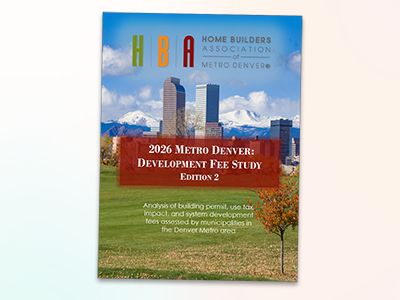
And it shows up in a separate 2026 study too. The Home Builders Association of Metro Denver looked at 16 metro jurisdictions and found builders pay on average about $73,000 in development fees on a single-family detached home. About $57,000 on an attached home. Across the whole metro, that is the water everyone is swimming in.
Now connect the dots to what is actually happening on the ground.
Denver single-family building permit volumes have fallen 43% from their 2021 peak. That is the second-sharpest drop in the entire peer group. Only Salt Lake City fell harder. When you make it this expensive and this slow to build, builders build less. That is not ideology, that is just math.
And we already had a hole to fill. CSI previously estimated the Denver metro faced a housing deficit somewhere between 64,000 and 135,000 units back in 2024. So we are short tens of thousands of homes, and the fee structure is quietly discouraging the exact thing that would fix it.
Relative to median household income, Colorado now ranks as the 12th-least-affordable state for single-family homes. Twelfth. That is the whole thing in one stat.
The report got a real spotlight on August 16, 2026, in a Gazette perspective piece by Peter F. LiFari. He is the CEO of Maiker Housing Partners, an affordable-housing authority in Adams County, and he is CSI's housing fellow. So this is not some anti-housing crank. This is a guy whose day job is literally building affordable housing.
LiFari calls housing affordability Colorado's most consequential issue in 2026. And when the person running an affordable-housing authority is pointing at government fees as the problem, that is worth your attention.
Here is the thing though. EHA was designed with a good goal. Build affordable homes as market-rate homes go up. Nobody sane is against affordable housing. But the report makes a hard case that the tool we picked, a linkage fee five times anyone else's, plus a 209-day wait, plus a water fee that leapfrogged the national average, is quietly making every single home more expensive.
Including the affordable ones. That is the part that should bother everyone.