 Revolutionizing · Modernizing · Simplifying
Revolutionizing · Modernizing · Simplifying
Revolutionizing · Modernizing · Simplifying
Hayley and I have a one-and-a-half-year-old. So yeah, we have been paying very close attention to this story.
Colorado's public schools just posted their steepest enrollment drop since the pandemic. More than 10,000 students gone in a single year, hitting every one of the state's ten largest districts. Denver Public Schools alone shed about 1,200 students this year. And DPS is already projecting another 6,000 gone by 2029, which almost certainly means more school closures on top of the ten that have already been shut down over the last few years.
So the obvious question is: where are all these kids going?

State Education Commissioner Susana Córdova is pointing at falling birth rates and shrinking populations in nearly a third of Colorado counties. Others are pointing at President Trump's immigration enforcement crackdown. And look, those are real factors. New-to-country students have been propping up enrollment numbers in recent years. Now they are leaving schools faster than they are arriving.
But here is the thing. Those explanations do not tell the whole story.
Because at the exact same time public school enrollment has been sliding year over year since 2022, homeschooling in Colorado has been going in the opposite direction. Up. Consistently. Every year.
The Colorado Department of Education's own press release from last week reported a 1.2% decline in district enrollment for the 2025-2026 school year. That same report also showed a 5.5% increase in full-time homeschoolers. Same report. Same year. One number going down, one going up.
Since 2022, the number of homeschool families in Colorado has climbed nearly 20%.
And here is the kicker: that 20% figure is almost certainly an undercount. Colorado actually has three different legal pathways for home education, and the state data only captures families operating under one of them. So the real number is likely higher than what the government is tracking.
Christian Home Educators of Colorado, CHEC, hosted two "how-to-homeschool" seminars earlier this month in Castle Rock. Nearly 125 families showed up. And some of them were public school teachers themselves.
That detail stopped me.
Christian Horstmann, a homeschool graduate who works for CHEC and wrote a piece on all of this for the Rocky Mountain Voice, noted that the seminar attendance is a direct reflection of what is happening statewide. Families are actively looking for a way out, or at least a door to walk through.
When seminar attendees were asked why they were considering home education, the answers came back consistent: bullying and traumatic situations at school, frustration with curriculum and teaching methods, and a search for a faith-based alternative to what they felt were competing ideologies being taught to their kids.
One mom told Horstmann that her district's recent school board election was the final straw. She pulled her eighth grader immediately and started homeschooling her. By her account, both of them are thriving.
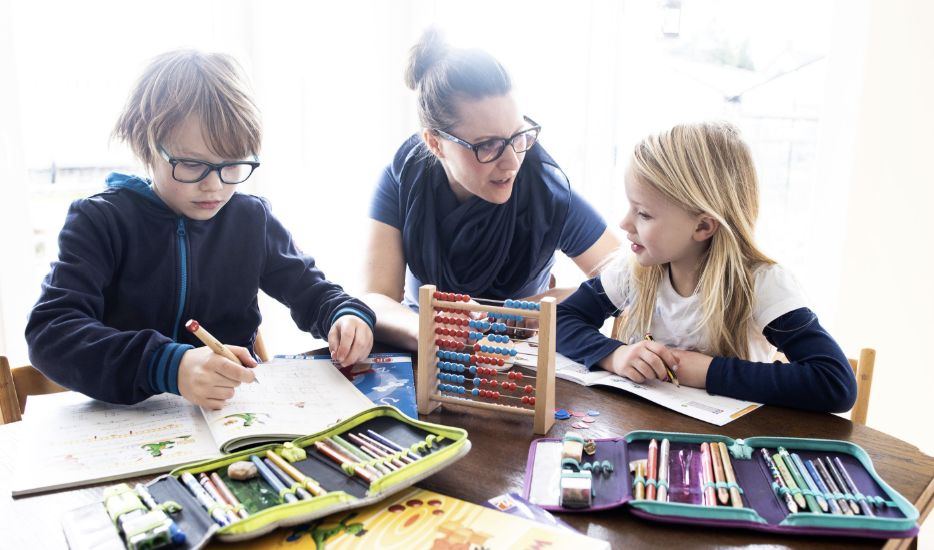
Pew Research has been tracking homeschool motivations, and the data is pretty striking.
School safety is the number one reason, cited by 83% of homeschool parents. And honestly, that tracks. Gallup has found that roughly 4 in 10 parents of school-age children are afraid for their kid's physical safety at school. That number has been elevated for four years running.
Academic quality comes in second, as a concern for nearly three-quarters of homeschool families. And if you look at Colorado's public school performance data, it is not hard to understand why. Colorado was happy to report a small uptick in 11th grade math proficiency last year. Small being the operative word. The share of 11th graders meeting the SAT math benchmark was still sitting below 33%. So fewer than one in three Colorado high school juniors are hitting the math bar. That is a real problem.
Religious and values-based instruction matters to about 53% of homeschool parents. And this is not just about religion in the narrow sense. The core point is that education is never value-neutral. Parents who feel like the values being taught in classrooms are not aligned with what they are teaching at home are increasingly deciding to take that piece back.
Beyond those top three, 72% of homeschool families say they simply want more time together as a family. That one hits different when you have a toddler at home.
A lot of families are also finding that home education does a better job of meeting their kids' specific needs, especially children who need a more individualized approach than a traditional classroom can offer. Stacie Graver, a Colorado homeschool mom quoted by the Denver Gazette last year, put it simply: "The beauty of homeschooling is you can modify based on the student."
One more thing worth noting, because this came up during the most recent DPS school board campaigns.
Overcrowded classrooms were presented as a problem to solve. The reality is almost the opposite. Only 8% of DPS elementary classrooms have 30 or more students. About 21% of them have 19 or fewer. The schools are not bursting at the seams. They are emptying out.
That matters for the real estate picture too, by the way. Schools are anchor institutions in neighborhoods. When DPS closes a building, it affects property values, it affects neighborhood identity, and it affects where young families decide to plant roots. We have already seen ten closures. If the district loses another 6,000 students by 2029, that number goes higher.
Colorado has had growing public school enrollment every single year for three decades straight. That streak ended in 2022. It has not recovered.
Hayley and I are in the middle of thinking through all of this ourselves. Our son is only 18 months old, so we have some runway. But watching these numbers move, talking to families who have made the switch, and understanding that the homeschool community in Colorado today looks nothing like the isolated experience people might picture (co-ops, group classes, field trips, real community) makes this feel like a serious conversation worth having early.
If you are already homeschooling, you probably recognize your family's story somewhere in these stats. If you are not but you are starting to ask questions, CHEC's website at chec.org has a solid breakdown of how Colorado homeschool law actually works and what your options are under all three legal pathways.
The public school enrollment picture in Colorado is not a blip. It is a trend. And a growing number of families are deciding they want something different. That is worth paying attention to.