 Revolutionizing · Modernizing · Simplifying
Nine thirty in the morning until ten thirty at night. That is thirteen hours of banjo, under one roof, on one Saturday in Denver.
Most people hear the word banjo and go straight to a punchline. A porch. A hillbilly joke. Something from a movie you do not want to admit you watched. And that is exactly the thing Swallow Hill is trying to fix with BanjoFest. Because the real story on this instrument is that it has deep African roots, and it has been one of the most misunderstood pieces of the American music world for a very long time.
So on Saturday, November 14, 2026, Swallow Hill Music turns its building at 71 E. Yale Ave. into a full day built around it. Doors at 9:30 a.m. The whole thing runs until 10:30 at night. This is the third year they have done it, and it has grown into one of the more quietly ambitious things happening in the Denver folk scene.

Here is the part people miss. If you actually want to get good at banjo, your options have historically been kind of brutal. You either shell out for one of those elite banjo camps, which are not cheap and not exactly beginner friendly, or you book private lessons and grind away alone in your living room. There was no middle ground.
BanjoFest launched to be that middle ground. A day where a curious listener who has never touched the thing and a seasoned picker who has been playing for twenty years can both show up and get something out of it. The daytime is all workshops and hands-on activities, led by the performers themselves and by Swallow Hill's own teachers. You pair a concert with actual learning. You are not just watching. You are doing.
And the caliber of people they bring in is the real flex here. In 2024, attendees got to rub elbows with Tony Trischka and Dom Flemons in an informal, educational setting. If those names do not mean anything to you, trust me, in the banjo world that is like finding out two of the greatest players alive are just hanging around the building answering your questions. That is not a thing that normally happens.
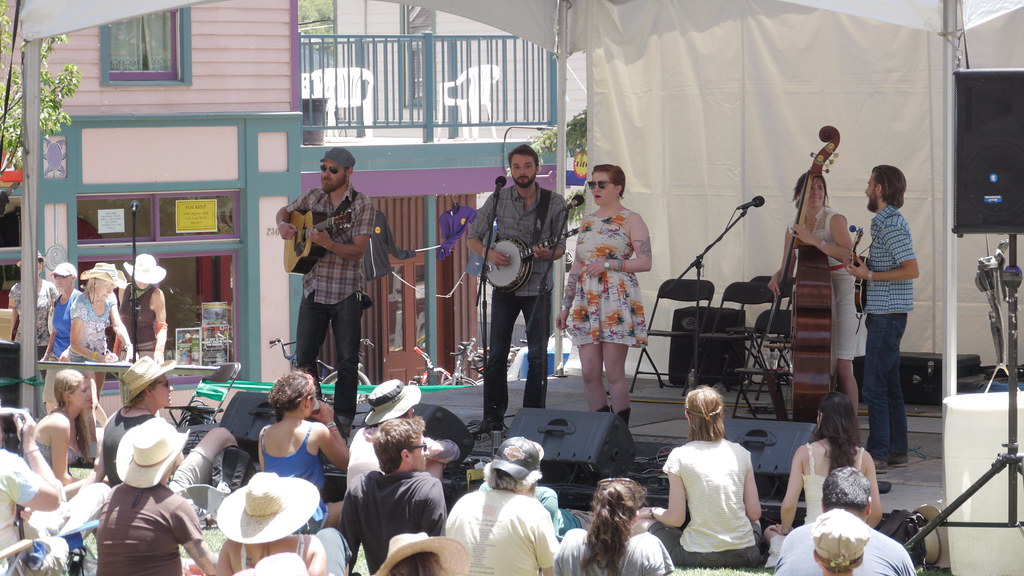
Once the sun goes down, it turns into a proper concert.
The evening bill features Kaia Kater, the duo of Allison de Groot and Nic Gareiss, and Natalie Spears. Kater has built a reputation for taking the banjo somewhere thoughtful and modern, pulling on those deep roots instead of running from them. De Groot and Gareiss are a pairing of clawhammer banjo and percussive dance, which, if you have never seen it live, is honestly hard to explain and better to just experience. Spears rounds it out.
The point is you get the whole arc in one day. Morning workshop. Afternoon activities. Then a night of watching people who are flat out great at this.
Tickets run $57.79 and up for the full day. If you are a Swallow Hill member, there is a discount code that knocks $5 off full-day passes, so dig that up before you check out.
And this is the part worth sitting with. Swallow Hill is a Denver nonprofit. So when you buy a ticket, you are not padding some corporate margin. That money goes back into their music classes, their concerts, and their preschool music programs. You are basically funding a kid's first experience with music while also learning to play a banjo yourself. Not a bad trade.
The festival is presented by the Denver Folklore Center, KGNU Community Radio, and Southwest Airlines. The Denver Folklore Center is also set up as a featured vendor, which is dangerous for me and probably for you too. They are bringing new, used, and vintage banjos, both open-back and resonator, from brands like Deering, Gold Tone, Pisgah, and Rickard. So if the morning workshop lights a fire and you suddenly decide you are a banjo person, there is a table standing right there ready to turn that impulse into a purchase. You have been warned.
Quick note on where this sits, because it matters. Swallow Hill is down in University, near the Harvard Gulch area, just off Yale. This is one of those south-central Denver pockets that has stayed genuinely livable while half the city got priced into the stratosphere. Tree-lined, walkable, close to the light rail, the kind of area where people actually stick around for decades. A nonprofit music school anchoring a neighborhood like that is a big part of why it feels the way it feels. Culture that is not going anywhere does real things to a place, and if you ask me it is one of the more underrated things a buyer should be paying attention to.
So. One Saturday. Thirteen hours. An instrument most people have decided they already understand, taught by people who will prove them wrong.
If you have been meaning to finally sit down with a banjo, or you just want a night of music that goes somewhere unexpected, November 14 is the day. Doors at 9:30 a.m. Bring curiosity. Leave your banjo jokes at the door.